
There is a moment, not loud, not dramatic, when something in us stops listening. Not to others, but to ourselves. To the body. To the seasons. To that quiet intelligence that does not argue, does not justify, but knows. And we call it progress.
We have learned how to smooth everything. Cycles made optional. Rhythms made inconvenient. The unpredictable managed, softened, regulated. Clean. Controlled. Optimised. We erase symptoms and call it healing. We replace sensation with simulation. We protect ourselves from life, and then wonder why we feel slightly numb, slightly off, as if something essential is missing but impossible to name.
The body, however, does not operate like a system we can endlessly adjust without consequence. It remembers. It adapts until it cannot. And then it speaks, often louder than we would like.
We walk through cities on plastic soles, over sealed ground, disconnected from the simplest physical reality of being human, and then we buy grounding devices to recreate what bare feet on soil have always offered.
We spend entire days under artificial light, then struggle to sleep. We regulate every space to the same temperature, summer and winter alike, moving from overheated rooms to air-conditioned interiors that erase the very feeling of the seasons, and slowly lose the body’s ability to adapt, to respond, to feel the world as it is.
We fill every silence with sound, and then wonder why our inner voice feels distant, or difficult to hear.
We have also learned to fear what is alive. Soil is called dirty, something to be scrubbed away, sanitised, avoided. Yet the real contamination comes from what we have added: plastics, chemicals, residues that do not belong to any natural cycle. A child playing in the earth is seen as something to clean immediately, while we accept without question environments saturated with synthetic materials. Somewhere in that inversion, something deeply human has been quietly dismissed.
We package everything. Food wrapped in layers of plastic. Fruit handled with gloves so we do not touch what we are about to eat. Umbrellas covered before entering a shop so that no drop of rain reaches the floor. The world becomes increasingly sterile, controlled, contained, and yet nothing feels truly clean. Only distant.
Even our relationship to the body becomes something to manage rather than inhabit. Functions are suppressed, regulated, adjusted for convenience, for comfort, for predictability. Cycles are muted or erased so they no longer interfere. Birth is timed, scheduled, streamlined, made to fit calendars and systems. And more often than not, it is women’s bodies that are asked to adapt, to regulate, to become quieter, more predictable, while elsewhere we still shrug and say “boys will be boys.” Much of this can be necessary, even life-saving. And yet, something shifts when what was once a powerful, rhythmic, embodied experience becomes something to control, contain, and optimise.
And at the same time, we see a rise in conditions that seem to speak precisely through those systems we have tried to quiet. Cycles that become painful, heavy, or unpredictable. Conditions like endometriosis, hormonal imbalances, chronic fatigue, bodies that feel out of sync with themselves. We respond with more regulation, more intervention, more attempts to stabilise what feels unstable. Sometimes it helps. Sometimes it doesn’t. It is not a simple equation, and it would be careless to pretend it is. And yet, it invites a question that lingers underneath: what happens when we repeatedly override rhythms we do not fully understand?
There is also a growing belief that everything about us can be defined, reassigned, redesigned according to will. That identity, biology, experience can be entirely separated, reorganised, declared independent from what is given. This is not about denying lived experience or individual truth, but about noticing a broader pattern: the quiet certainty that we know better than the forces that shaped us. That nature is something to refine, correct, or transcend.
And perhaps this is where the fracture begins. Not in change itself, but in the assumption that there is nothing in us that should remain imperfect, untamed, unaltered, beyond optimisation.
We have created an entire industry to compensate for this disconnection. Complex routines, expensive tools, systems designed to help us feel better, calmer, more aligned. And yet many of these are simply attempts to recreate, in controlled conditions, what was once freely available: sunlight, movement, rest, contact, silence, soil, rhythm.

This is not a call to reject modern life or to return to some imagined past. It is something quieter, and perhaps more unsettling. A question.
What happens when everything becomes adjustable, controllable, modifiable, except the part of us that knows that something is off?
Somewhere in all of this, there is also a quieter story, one that lives in the body without always being spoken. A soft dulling of instinct. A second-guessing of sensation. A tendency to look outward before trusting what is felt within. Not dramatic enough to name, not visible enough to question, and yet present in the way many women learn, slowly, to adjust, to accommodate, to smooth their own edges. To live slightly removed from that deep, animal knowing that does not explain itself, but simply is.
Something we feel… but no longer fully follow. Perhaps that is what feels so difficult to name.
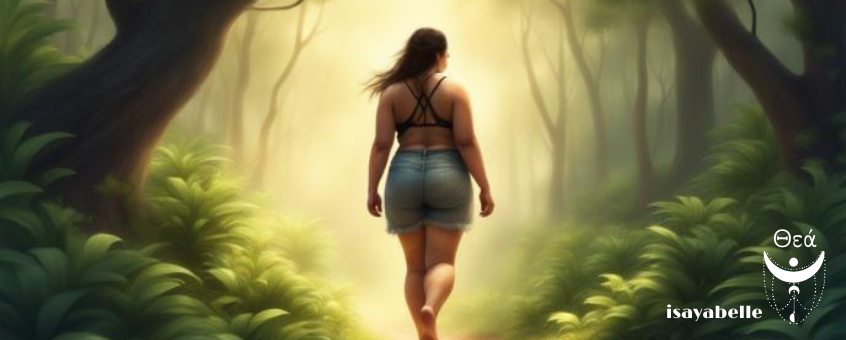
Artemis does not try to answer this. She does not optimise. She does not sanitise. She does not negotiate with what is wild. She moves with instinct, with precision, with an intelligence that does not need to explain itself. She walks barefoot on the ground we have covered, touches what we have learned to avoid, follows rhythms we have tried to outgrow. She belongs, not because she makes an effort to reconnect, but because she never agreed to leave.
And maybe that is the real question. Not how to reconnect, not what method to follow, not what system to adopt.
But when did we begin to walk away from something that had always held us… and why?
If something in you is reading this and not arguing, but recognising…
then you already know this is not just an idea.
It is a remembering.
And remembering rarely happens through thinking more.
It happens through stepping out of the noise
and back into what is real.
This is why I created Living a Goddess Life Initiation.
Not as an escape from life,
but as a return.
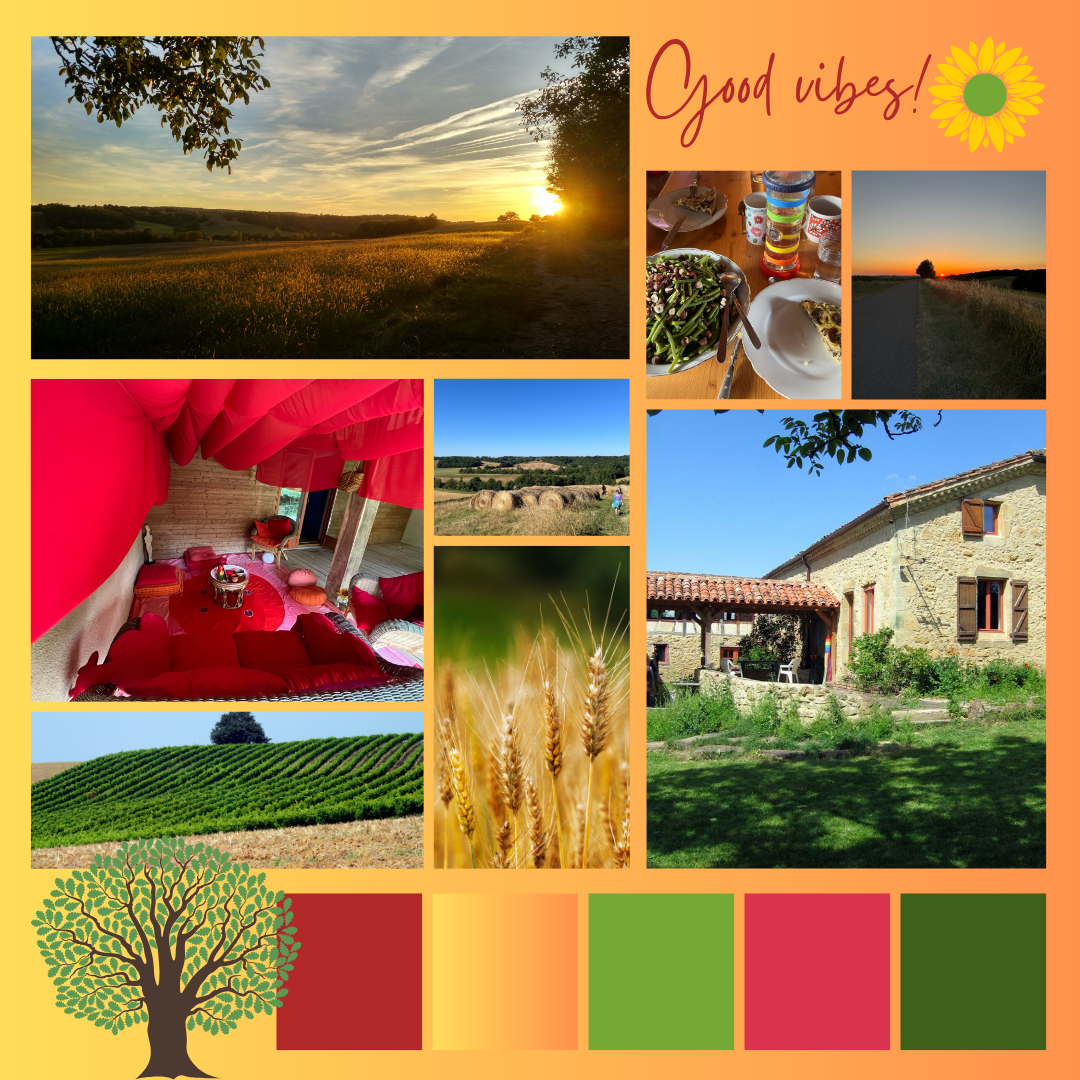
Five days in the French countryside, in a small circle of women, where we slow down enough to actually feel again. To walk on the land, to breathe differently, to listen to the body without immediately trying to fix it, optimise it, or silence it.
Through ritual, presence, nature, and shared space, something shifts quietly. Not forced. Not dramatic. But real.
You don’t learn how to reconnect.
You remember that you never fully lost it.
If you feel the pull of that… you can explore the retreat here:
https://isayabelle.com/lagl.initiation
Or come and talk to me directly. No pressure, no performance. Just a conversation.
I keep these circles small, by design.
If you know a sister, a friend, a fellow Goddess on the path who might need this too, feel free to share this article with her.
In truth,
Isaya